Hives, vomiting or wheezing after drinking milk may be due to cow's milk protein allergy or another cause. A correct diagnosis avoids needless restrictions.
Not every child who feels unwell after drinking milk has an allergy. Getting the diagnosis right means your child does not have to avoid foods unnecessarily and still gets enough nutrients to grow.
What milk allergy looks like
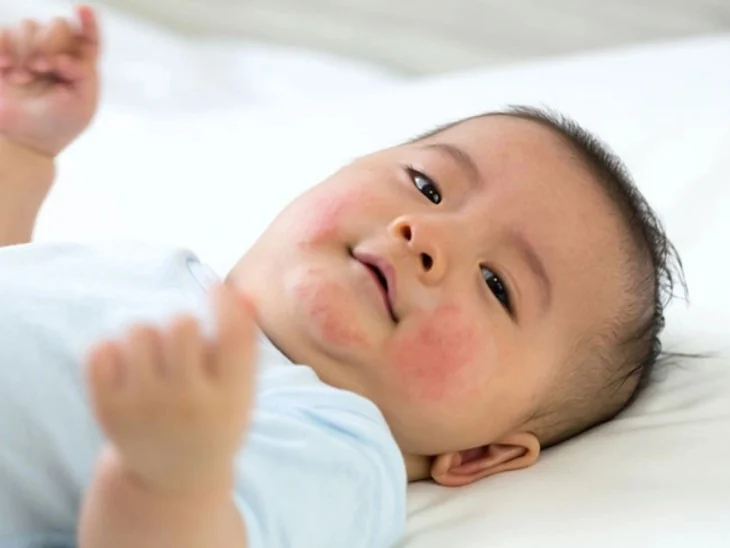
Cow's milk protein allergy happens when the immune system reacts to the proteins in cow's milk. It is common in young children, especially in the first few years of life. Depending on the mechanism, a child may react almost immediately, or the signs may only appear some time later. Common signs include:
- Hives, swollen lips or a swollen face.
- Vomiting, stomach pain, diarrhea, blood in the stool.
- Coughing, wheezing, difficulty breathing.
- Fussiness and crying, poor feeding.
Some children only have digestive symptoms, so it is easily mistaken for an ordinary digestive upset. On the other hand, spitting up, bloating, diarrhea or fussiness can have many other causes. So the fact that a child feels unwell after drinking milk is not enough on its own to conclude it is an allergy.
How doctors make the diagnosis
The doctor will ask in detail: when the symptoms appeared, what type of milk the child drank and how much, what other signs came with it, and whether the child or anyone in the family has allergies.
Depending on the case, the doctor may order a blood test to measure IgE antibodies specific to cow's milk protein, or a skin prick test. The results must be interpreted by the doctor alongside the actual symptoms, because a positive test does not necessarily mean the child will react when consuming milk.
When things are still unclear, the doctor may use an oral food challenge, which is regarded as an important reference method when the history and test results are not clear enough. The child is given milk in gradually increasing amounts following a strict protocol and is closely monitored for any reaction. This should only be done by trained health workers, in a place with emergency equipment ready in case the child reacts strongly.
If your child has ever reacted clearly to milk, especially with difficulty breathing, swollen lips or tongue, low blood pressure or a whole-body reaction, never give them milk again at home to test it yourself.
Milk allergy is different from lactose intolerance
Many people confuse these two conditions. Lactose intolerance is when the body does not have enough of the enzyme lactase to break down lactose, the sugar in milk, causing bloating, stomach pain and diarrhea after consuming milk and products containing lactose. With an allergy, it is the immune system itself reacting to the protein part of the milk.
Different mechanisms mean different management. Parents should not switch to another type of milk on their own or cut out milk and dairy foods completely without guidance from a qualified professional.
What to do if you suspect a milk allergy
- Write down the type of milk, the amount your child drank, when the symptoms started and exactly what they were. These notes help the doctor make a better assessment.
- Take your child to a doctor right away if there is a clear reaction after drinking milk: hives spreading over the body, swollen lips or face, repeated vomiting, wheezing, difficulty breathing, sluggishness or any unusual whole-body signs. Difficulty breathing or signs of anaphylaxis are an emergency.
- If the reactions are mild but keep happening, take your child to a pediatric or allergy specialist. The doctor may have your child stop cow's milk for a while and then reassess to confirm the diagnosis.
- When cow's milk has to be avoided, your child still needs enough energy, protein, calcium, vitamin D and micronutrients to grow. For young children, ask a doctor or nutritionist before choosing a substitute milk.
Trusted clinic for cow's milk protein allergy in children in Ho Chi Minh City
With nearly 20 years of experience and a team of highly qualified doctors, Ky Hoa Medical Center is a familiar choice for many families in Ho Chi Minh City when they need care for cow's milk protein allergy in children. Here, our Pediatrics doctors take time to listen, examine carefully and explain clearly so that you fully understand your child's condition, then agree together on a care and follow-up plan.
The center operates under Operating License No. 00449/HCM-GPHĐ, with a list of medical techniques approved by the Ho Chi Minh City Department of Health (Decision 471/QĐ-SYT), and is a primary care facility contracted with Ho Chi Minh City Social Security, accepting health insurance (BHYT) visits on Saturdays as well. The practising certificates of our 24 doctors are published on our Doctors page.
When your child shows signs of a possible allergy after drinking milk, you can bring them to the Pediatrics department at Ky Hoa Medical Center, where a doctor will examine them and advise on alternative foods and suitable monitoring; simply walk in during opening hours and take a queue number. If your child has difficulty breathing or swelling of the lips or face, take them to the nearest medical facility right away.
Ky Hoa Medical Center
Address: 266A - 268 3 Thang 2 Street, Hoa Hung Ward, Ho Chi Minh City
Opening hours: Monday to Saturday, 6:30 - 11:30 and 13:00 - 17:00 (closed on Sunday)
Hotline: 028.3868.1097
Source: Suc Khoe & Doi Song (Health & Life) newspaper