

Switching the fats you choose, adding soluble fiber and sticking with a menu that suits you are simple steps that help improve blood cholesterol.
For many people, changing their meals alone is enough to see their cholesterol numbers improve. Eating less red meat, choosing lean cuts, and adding more vegetables, fruit and whole grains are steps that can lower blood cholesterol considerably. Below are four adjustments you can start making right away at the family dinner table.
Switch the fats on your plate
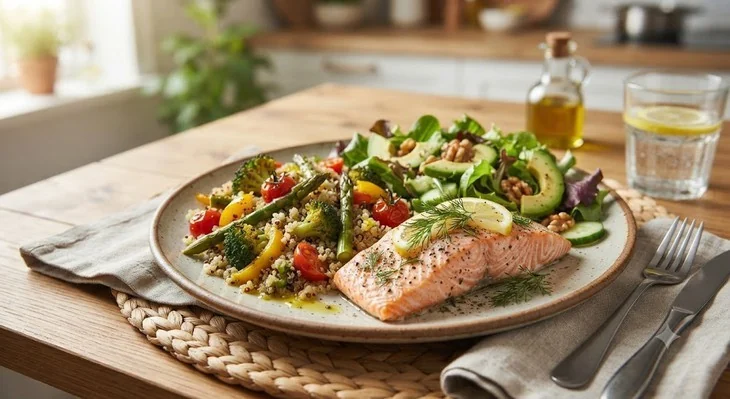
Most vegetable oils contain unsaturated fats. Using these fats in place of saturated fats benefits the heart and blood vessels. Besides cooking oil, you can find these fats in oily fish, nuts and seeds, and some vegetables.
Meanwhile, dishes high in saturated fat should be eaten less often. It is "swapping" bad fats for good fats, not cutting out fat entirely, that helps improve blood lipids.
Eat more soluble fiber
Soluble fiber can help lower blood cholesterol. Easy-to-find sources include:
- Oats.
- Fruit.
- Beans and legumes.
Fiber works better as part of an overall healthy diet, meaning one that also favors unsaturated fats over saturated fats as described above.
Plant sterols and stanols
These are naturally occurring compounds with a structure similar to cholesterol. When they are present in a meal, they reduce the amount of cholesterol the gut absorbs into the body.
Some foods, such as margarine spreads, fruit juices and yogurts, now have these two compounds added. That can be one way to increase your daily intake of sterols and stanols, but you should ask your doctor which option suits your condition.
Find a menu that suits you
When people hear an acquaintance say a certain way of eating lowered their cholesterol, many want to follow it straight away. Yet people respond differently to the same diet.
If you have followed a diet for a while and your numbers have not dropped as much as you hoped, do not rush to conclude it is useless. Your constitution, lifestyle, how consistently you stick to it and many other factors all affect the result. No single menu works for everyone, so you may need to adjust and try a few different approaches to find a way of eating that suits you and that you can keep up long term.
Persistence is what matters
Diet is a simple way to improve cholesterol, but every body responds in its own way. So do not be discouraged if you have changed your menu and your cholesterol has not yet reached the level you want. Keep up your good eating habits. Even if your doctor prescribes medication to control blood lipids, a healthy diet still plays an important role in protecting your heart and blood vessels.
Trusted clinic for high cholesterol in Ho Chi Minh City
For nearly 20 years, Ky Hoa Medical Center has cared for the health of people in Ho Chi Minh City, bringing together highly qualified doctors who are attentive at every visit. When high cholesterol needs checking, our Internal Medicine doctors take time to listen, examine carefully and explain clearly so that you fully understand your condition, then agree together on a treatment and follow-up plan.
Laboratory tests is performed on site, so you can complete check-ups in one place, which makes follow-up visits easier.
The center operates under Operating License No. 00449/HCM-GPHĐ, with a list of medical techniques approved by the Ho Chi Minh City Department of Health (Decision 471/QĐ-SYT), and is a primary care facility contracted with Ho Chi Minh City Social Security, accepting health insurance (BHYT) visits on Saturdays as well. The practising certificates of our 24 doctors are published on our Doctors page.
If you want to know where your blood lipid levels stand, you can come to Ky Hoa Medical Center, where an Internal Medicine doctor will examine you, order suitable laboratory tests and advise you on your menu; simply walk in during opening hours and take a queue number.
Ky Hoa Medical Center
Address: 266A - 268 3 Thang 2 Street, Hoa Hung Ward, Ho Chi Minh City
Opening hours: Monday to Saturday, 6:30 - 11:30 and 13:00 - 17:00 (closed on Sunday)
Hotline: 028.3868.1097
Source: Suc Khoe & Doi Song (Health & Life) newspaper